An average age, not an absolute rule
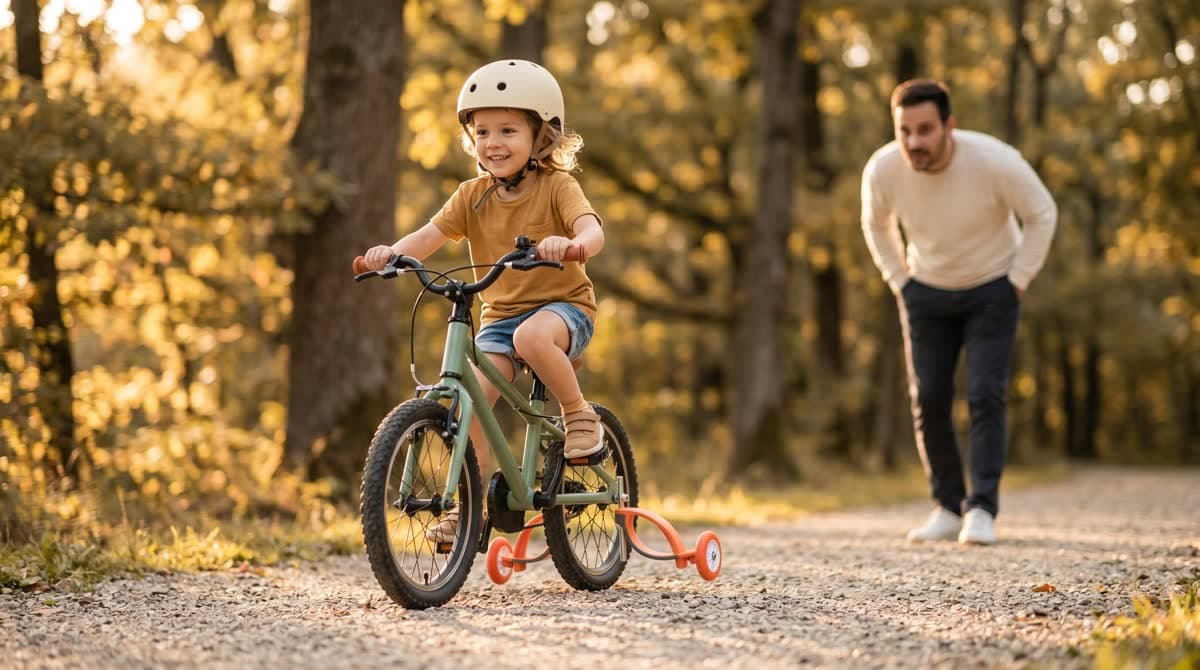
Most children can ride without training wheels between ages 4 and 6. Some manage as early as 3 and a half, others need to wait until they're 7. That wide range comes down to differences in motor development. A child who has spent plenty of time climbing, jumping and running will develop the necessary coordination earlier than a more sedentary one.
Age should never be the only criterion. What really matters is the combination of physical readiness and psychological confidence. Pushing a child who isn't ready can create a lasting fear of cycling.
Physical signs of readiness
Motor development follows a predictable pattern. Before considering the move to two wheels, check that your child has these skills:
- Static balance: they can stand on one foot for at least 5 seconds without holding on. This simple test reveals the maturity of the vestibular system, which is essential for balance on a bike.
- Bilateral coordination: they pedal smoothly, without jerking. The circular pedaling motion requires coordination between both legs that not all children acquire at the same pace.
- Postural reaction: they catch themselves instinctively when losing balance. This reflex protects against serious falls and usually appears between ages 3 and 5.
- Enough strength: they brake effectively using the brake levers. If their hands are too small or too weak to brake, they aren't ready to ride unassisted yet.
Psychological signs to watch for
Confidence matters as much as physical condition. Watch for these indicators:
- The desire comes from the child: they say they want to ride "like the big kids." A motivated child progresses much faster than one being pushed by their parents.
- Frustration tolerance: they accept falling and trying again. Learning to ride involves temporary failures; a child who gets discouraged at the slightest wobble needs a more progressive approach.
- Focus: they can stay engaged in a physical activity for 10 to 15 minutes. Riding a bike means handling steering, pedaling, balance and surroundings all at once.
Why an abrupt transition causes problems
The classic method is to take off the training wheels in one shot and hold the saddle while the child pedals. This approach has several limits. First, the child goes from a fully stable system (four contact points) to an unstable one (two contact points) without an in-between step. The shock is real and can create a fear of cycling that's hard to shake.
On top of that, the parent holding the saddle creates a false sense of security. The child leans on that help instead of building their own balance reflexes. And the day the parent lets go, a fall is often unavoidable, with all the disappointment that follows.
The progressive approach: the smartest strategy
Research in motor development shows that gradual learning is more effective. The idea is to reduce assistance step by step rather than removing it all at once. That's exactly the principle behind flexible stabilizers like Baswil. See how it works.
Unlike rigid training wheels that prevent any tilt, a flexible stabilizer lets the bike lean naturally. Your child feels real balance sensations while keeping a safety net. They develop proprioception and coordination without the risk of a hard fall.
This approach works especially well for children between 3 and 6, the age range when motor development is fastest. With 2 to 4 weeks of regular use, most children gain the balance they need to ride completely unassisted.
How to track your child's progress
Instead of setting a date to remove the stabilizers, watch the actual progression:
- Phase 1: your child often leans on the stabilizers. That's normal at the start, they're building confidence.
- Phase 2: the stabilizers touch the ground less and less. Natural balance takes over.
- Phase 3: your child rides long distances without the stabilizers ever touching down. They're ready for two wheels.
This self-regulating system removes the question of "the right moment": it's the child who decides, through their own progress, when they no longer need help.
Practical tips to support the transition
- Choose flat, smooth ground with no traffic for the first sessions.
- Always fit your child with a properly adjusted helmet. Knee pads are a plus.
- Favor short sessions (15-20 minutes) on a regular basis rather than one marathon ride.
- Praise the effort, not just the result. "You handled that turn well" beats "You didn't fall."
- Never compare your child's progress with another's. Every learner is unique.
Frequently asked questions
At what age should you remove training wheels?
Most children remove their stabilisers between ages 4 and 6. Some manage as early as 3 and a half, others closer to 7. Age matters less than genuine readiness: trust the signs you observe rather than a fixed date. A flexible stabiliser with springy blades, which reduces support gradually, often brings this moment forward.
How do I know if my child is ready to ride without stabilisers?
Your child is ready when they pedal easily, control the braking confidently, hold balance for a few seconds while coasting and express a clear wish to try without stabilisers. Confidence matters just as much as physical fitness here: never push a reluctant child.
My child is 6 and still needs stabilisers, is that normal?
Yes, that is entirely normal and common. Motor development varies greatly between children, and some need to wait until 7 to ride alone. What matters is steady progress, not age. A gradual transition rather than an abrupt one clearly speeds up learning.
Why not remove training wheels all at once?
Removing stabilisers abruptly takes the child from a stable four-point system to total instability. This jump often creates fear, falls and lost confidence. A gradual reduction of support, as with a flexible stabiliser, genuinely makes learning balance safer and easier.
How long does it take to learn to ride without training wheels?
With a progressive approach, most children ride unaided within 2 to 4 weeks of regular sessions. The timing depends on age, frequency and method. Short sessions of 15 to 20 minutes several times a week, using a flexible stabiliser that preserves leaning, prove the most effective.
Do you need a helmet to learn to ride without stabilisers?
Yes, a helmet fitted to the EN 1078 standard is essential from the very first sessions without stabilisers. It should sit flat, two fingers above the eyebrows, with the chin strap snug. Knee pads and flat traffic-free ground complete the safety.
What age to start a balance bike before a pedal bike?
A balance bike can be used from 18 months to 2 years to build balance before pedalling. A child used to a balance bike often moves to a bike without stabilisers very quickly, sometimes with no intermediate phase, as the hardest balance skill is already mastered.
How can I support my child during the transition?
Choose flat, smooth ground, favour short but regular sessions, and praise effort rather than results alone. Never compare their progress with another child's. A flexible stabiliser lets you reduce support gradually, at the child's own pace and comfort level.
Baswil: a smooth transition
The Baswil flexible stabilizer installs in a few minutes on 12 to 16 inch bikes, including Btwin Decathlon. At €52, it's a modest investment for a calm, gradual transition to riding without training wheels.
Shop Baswil