Where does the fear come from?
Fear of cycling isn't a tantrum. It rests on well-known biological and psychological mechanisms. Between ages 3 and 6, your child develops awareness of danger. They understand that a fall hurts, that speed can be uncontrollable, that the ground is hard. That's not cowardice, it's intelligence.
Several factors fuel this apprehension:
- A previous fall, even minor, that left a negative memory
- A felt lack of control on an unstable bike
- Social pressure (a sibling or friend who already rides)
- A bike unsuited to their size, or too heavy
- Anxiety unintentionally passed on by parents
Once the source is identified, you can act methodically. Here are 7 concrete approaches, ordered from simplest to most structuring.
1. Create a safe environment
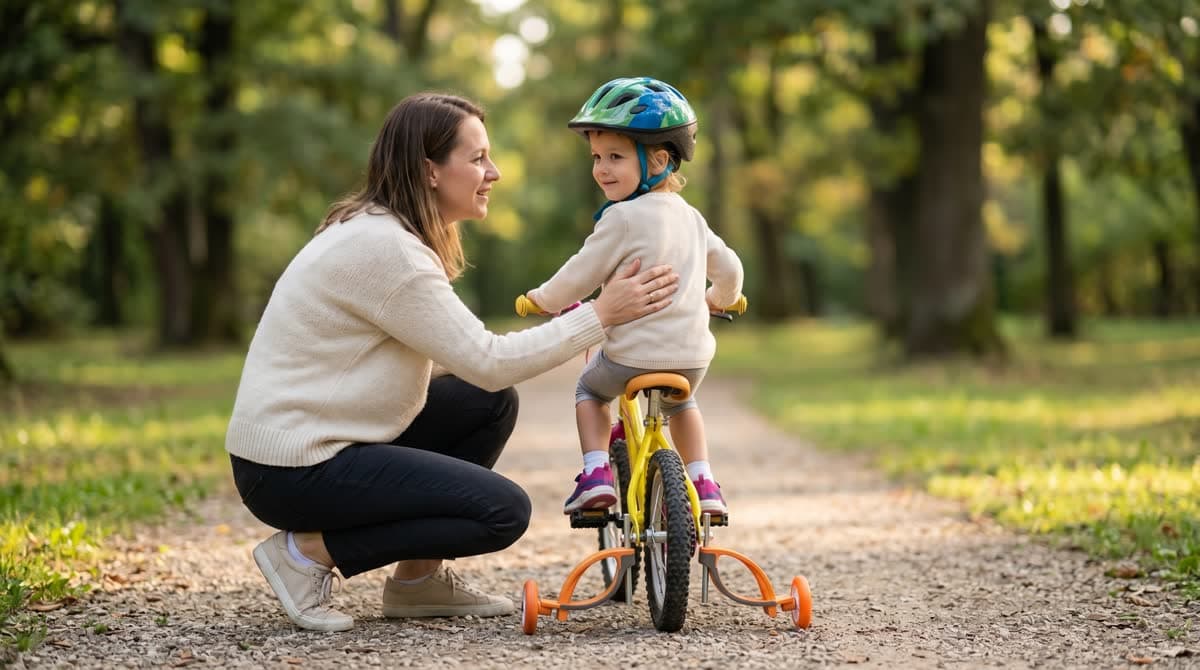
The physical environment directly shapes your child's confidence. An empty parking lot on a Sunday morning, a flat path with no traffic, a schoolyard after hours: pick an open space with no slope and no obstacles.
Avoid busy parks where your child feels watched. Fear of judgment exists even at age 4. A calm, predictable, low-stakes setting is the first lever for motivation.
2. Check and adapt the gear
A bike that's too big, a saddle too high, brakes too stiff: all factors that amplify insecurity. Your child should be able to plant both feet flat on the ground when seated. The bike should be light (ideally under 8 kg for a 14-incher).
The helmet should be comfortable and well fitted, never presented as a sign of danger but as normal gear, like shoes. Knee pads can reassure children especially sensitive to falls.
3. Progress in micro-steps
Gradual exposure is the most effective technique against apprehension. Never ask a frightened child to "just try pedaling." Break it down:
- Day 1: sit on the bike at a stop, feet on the ground
- Day 2: walk forward while seated on the saddle
- Day 3: lift feet for a few seconds on a very gentle downhill
- Day 4: place one foot on a pedal, push with the other
- Day 5 onward: pedal a few meters with support
Each step can take a day or a week. The pace belongs to your child, never to the parent. This progression builds independence without forcing it.
4. Lead by example without imposing
Children learn by imitation. Ride next to your child on your own bike. Show that you brake too, that you sometimes put a foot down, that you go slowly. Narrate it: "See, I'm slowing down here because the path turns."
If an older sibling already rides, plan short family outings where your child can observe without pressure. Encouragement by example beats a thousand speeches.
5. Celebrate every small win
"You held on for 3 seconds without putting your feet down, that's 1 second more than yesterday." That kind of factual, positive feedback builds confidence far better than a generic "good job." Name precisely what your child achieved.
Avoid comparisons ("your cousin already knew at your age"). Every child has their own motor developmental rhythm. Intrinsic motivation is built through recognition of progress, not pressure to perform.
6. Prepare physically
Balance on a bike calls on core strength, coordination and proprioception. Some children simply don't yet have the motor capacities required, and forcing won't help.
Complementary activities strengthen these skills with no direct link to cycling: walking on a low beam, riding a scooter, hopping on one foot, dancing. The balance bike remains an excellent prep tool for the youngest. Check our article on teaching cycling at age 3 for an age-appropriate program.
7. Choose the right support tools
Classic (rigid) training wheels create a major issue: they prevent the bike's natural lean and block balance learning. The result: when you take them off, your child has learned nothing and the fear comes back, sometimes stronger than before.
A flexible stabilizer like the Baswil works differently. Its flexible blades let the bike lean naturally in turns while catching your child before a fall. Your child develops balance progressively, in real conditions, with an invisible safety net.
This approach significantly reduces fear because your child feels in control of the bike. There's no abrupt moment when you "take off the wheels." The transition happens naturally, at the pace of confidence built. To understand the difference with classic training wheels, read our comparison on removing training wheels without stress.
Frequently asked questions
Why is my child afraid of the bike?
Fear of the bike comes from the normal development of danger awareness between ages 3 and 6. The child understands that a fall hurts and that speed can feel uncontrollable. Often a past fall, an unsuitable bike or parental anxiety adds to it.
Is it normal for a 4-year-old to be afraid of cycling?
Yes, it is perfectly normal and common between ages 3 and 6. This fear is not a tantrum or cowardice: it is a sign of intelligence and developing danger awareness. It turns into confidence with a suitable framework and respectful progress.
How do you help a child who is afraid of the bike?
Create a safe, slope-free environment, check the gear, then progress in short micro-steps at the child's pace. Set an example without imposing, celebrate each precise step and use a suitable support tool that reassures without blocking balance learning.
What is the best age to overcome fear of the bike?
There is no fixed age: each child has their own motor development pace. The fear can be worked on from age 3 with a balance bike, then a suitable pedal bike. Forcing a child not physically ready is counterproductive and increases apprehension.
Do training wheels help a child who is afraid?
No, classic rigid training wheels often make the problem worse. They prevent the bike's natural lean and block learning balance. When removed, the child has learnt nothing and the fear returns, sometimes stronger than before that abrupt removal.
How do you progress in micro-steps against fear of the bike?
Break the learning into stages: sitting with feet on the ground, walking forward while seated, lifting the feet on a gentle slope, placing one foot on a pedal, then pedalling a few metres. A flexible stabiliser provides this support without blocking balance, each stage lasting a day or a week.
Should you force a child to ride a bike?
No, forcing a fearful child is counterproductive and only increases apprehension. The pace belongs to the child, never to the parent. Gradual exposure, sincere encouragement and reassuring gear build lasting confidence far more effectively than insistence, pressure or comparisons with other children.
Does the Baswil stabiliser reduce fear of the bike?
Yes. Its flexible blades let the bike lean naturally while catching the child before a fall. The child feels in control of their bike and develops balance in real conditions. There is no abrupt removal moment, which greatly reduces anxiety.
In summary
Fear of cycling isn't an insurmountable obstacle. It's a signal that your child needs an adapted setting, a respectful progression and tools that support rather than constrain. By combining a safe environment, micro-steps, sincere encouragement and well-designed gear, confidence settles in naturally.
The Baswil stabilizer was designed to address exactly this. Compatible with 12 to 16 inch bikes (including Btwin Decathlon), it installs in a few minutes and offers active balance learning, without the fear of falling.