How classic training wheels work
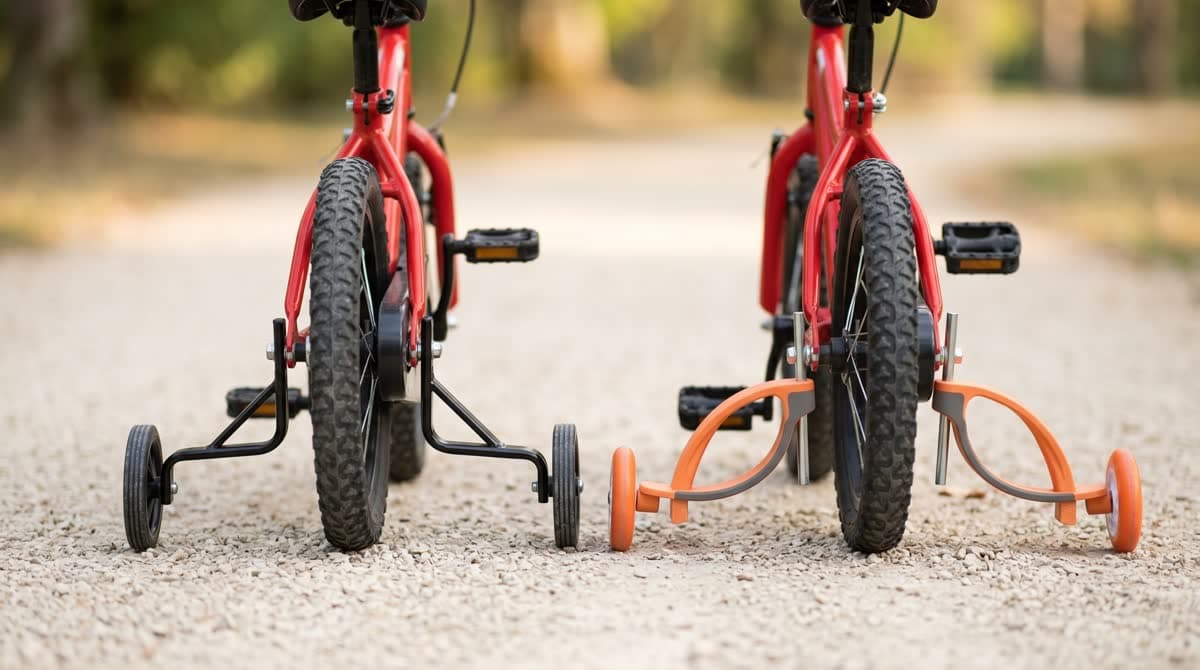
Rigid training wheels mount on either side of the rear wheel on metal rods. The principle is simple: keep the bike from falling by holding it vertical at all times.
And that's exactly where the fundamental problem lies. A bike that doesn't lean is a bike on which you don't learn balance. In biomechanics, cycling balance relies on the lean of body and bike in turns. It's called counter-pressure: to turn left, you tilt the bike slightly to the left, and the center of gravity shifts accordingly.
With rigid training wheels, that lean is physically impossible. Your child learns to pedal and steer the handlebars, but never learns to manage their balance. That's why removing the training wheels often means starting over: your child has no experience of leaning.
Expert test
I'm one of those people who say putting training wheels on a bike is pointless. It doesn't really help the child, it builds bad habits.
Aurélien Fontenoy
Three-time MTB trials world silver medallist
Test carried out in partnership with Baswil.
How a flexible stabilizer works
The Baswil stabilizer uses composite blades that flex under your child's weight. Unlike rigid rods, these blades allow natural lean of the bike up to a certain angle, then progressively resist to prevent a fall.
In practice, when your child leans right in a turn, the right blade compresses and follows the motion. If the lean exceeds the safety threshold, the blade touches the ground and stabilizes the bike. Your child learns in real conditions while staying protected.
To see the mechanism in detail, check our How it works page.
Biomechanical comparison
| Criterion | Rigid training wheels | Flexible stabilizer |
|---|---|---|
| Bike lean | Blocked | Allowed then dampened |
| Balance learning | None | Progressive and active |
| Center of gravity | Always centered (artificial) | Natural shift |
| Transition to 2 wheels | Abrupt (full removal) | Progressive (built confidence) |
| Turns | Handlebars only | Handlebars + lean |
| Tipping risk | High (one wheel in the air in turns) | Low (progressive damping) |
What parents actually observe
With rigid training wheels, parents typically see that their child pedals well, steers, brakes correctly. Everything looks dialed. But come removal day, surprise: the child can't hold balance, panics, and often refuses to get back on the bike.
With a flexible stabilizer, the picture is different. At first, your child often leans on the blades. Then, week after week, ground contact becomes rare. Your child leans more and more naturally. The day you remove the stabilizer, they're already riding, because active learning happened the entire time.
Typical transition timeline
Every child is different, but here's what we observe on average with a flexible stabilizer:
- Weeks 1-2: your child gets used to the bike, the blades often touch the ground. Confidence builds.
- Weeks 3-4: contacts drop noticeably. Your child starts leaning into turns instinctively.
- Weeks 5-8: the blades rarely touch. Your child rides in balance most of the time.
- Beyond: removing the stabilizer happens naturally, often at your child's own request.
With classic training wheels, this progression doesn't exist. The switch happens in a single day, from "all assisted" to "nothing," which explains the high failure rate and frequent frustration.
Which choice for your child?
If the goal is for your child to genuinely learn to ride a bike (not just pedal a disguised tricycle), a flexible stabilizer offers a clear structural advantage. It respects the biomechanics of learning and avoids the rupture moment that often triggers fear and regression.
For those still weighing different approaches, our article Balance bike vs training wheels: which to choose rounds out this analysis with a third option.
Frequently asked questions
What is the difference between a flexible stabiliser and classic training wheels?
Rigid training wheels hold the bike upright at all times and block leaning, so balance is never learnt. The flexible stabiliser uses blades that allow natural leaning then cushion before a fall, enabling active balance learning in real conditions.
Why don't training wheels teach balance?
Because a bike that does not lean is a bike on which you do not learn balance. Cycling balance relies on leaning the body and bike in corners. With rigid training wheels, this lean is physically impossible: the child pedals and steers without ever managing balance.
How does a flexible-blade bike stabiliser work?
Composite-material blades flex under the child's weight. When they lean in a corner, the blade compresses and follows the movement. If the lean exceeds the safety threshold, the blade touches the ground and stabilises the bike, protecting the child in real conditions.
Does a flexible stabiliser avoid the abrupt training-wheel transition?
Yes. With training wheels, the change happens in a day, from fully assisted to none, hence a high failure rate. The flexible stabiliser offers a gradual transition: ground contacts grow rarer week by week until natural removal, often requested by the child.
How long to move from the stabiliser to a bike without wheels?
On average, the child adjusts during weeks 1 and 2, ground contacts clearly drop in weeks 3 and 4, then they ride in balance most of the time between weeks 5 and 8. Removal then happens naturally, each child staying unique.
Which system to choose so my child really learns?
The flexible stabiliser has a clear structural advantage if the goal is real cycling learning. It respects the biomechanics of balance and avoids the break point that creates fear and regression. Training wheels only teach pedalling and steering.
What do parents observe with each system?
With rigid training wheels, the child seems to master everything, then panics at removal because they cannot balance. With the flexible stabiliser, support on the blades grows rarer gradually and the child already rides on removal day, active learning having occurred continuously.
Is the Baswil stabiliser compatible with all bikes?
Baswil is designed for 12–16 inch children’s bikes. Compatibility depends on the rear axle mounting point, not just the brand or wheel size. Check the guide before buying; if unsure, contact us with the model and a photo of the rear axle.
The Baswil stabilizer in practice
Compatible with compatible 12 to 16 inch kids' bikes (including Btwin Decathlon), Baswil installs in a few minutes with no special tools. Its flexible blades are designed to support active balance learning, with a natural transition to riding unassisted.
Price: €52. 30-day money-back guarantee.