
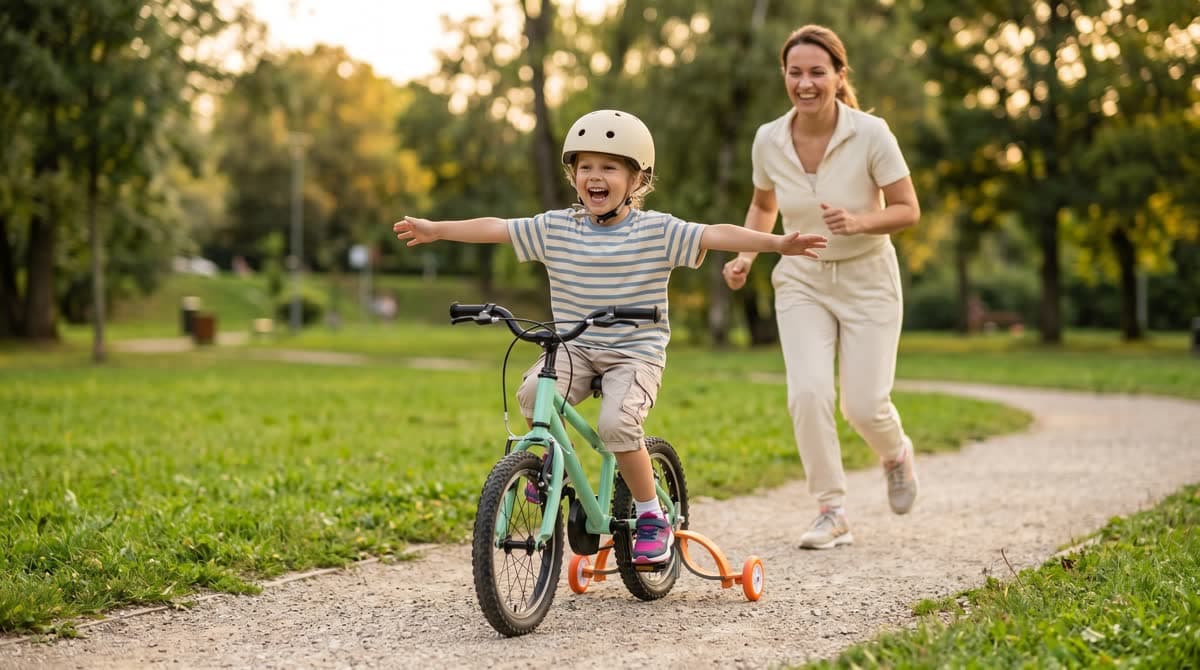
Why the classic method often fails
The usual scenario: you unscrew the training wheels, you hold the saddle, you push, you let go, the child falls. Some kids get up and try again. Many others refuse to get back on the bike for weeks. The problem isn't a lack of courage, it's the lack of a real progression.
Going from a four-contact-point system (two wheels + two training wheels) to two contact points in one moment is the equivalent of pulling off a child's water wings in the deep end. It can work, but it's a risky bet on your child's confidence. A graded approach is consistently more effective. Also avoid the common mistakes that delay learning.
Step 1: Set the stage
Check readiness
First, make sure your child shows the signs of readiness described in our article when to take off training wheels. Trying the transition too early is counterproductive.
Pick the right spot
Find flat, smooth ground with no traffic. An empty parking lot on a Sunday morning, a schoolyard or a quiet bike path are ideal. Avoid grass (too much resistance) and gravel (too unstable). The surface should let your child roll easily so they can focus only on balance.
Gather safety gear
- Helmet: required and well fitted (two fingers between the strap and the chin).
- Knee and elbow pads: recommended to reassure your child and limit scrapes.
- Gloves: optional but useful to protect palms in case of a fall.
- Long clothing: pants and long sleeves protect without getting in the way.
Step 2: Introduce flexibility
Rather than removing the training wheels in one go, use an intermediate phase where your child discovers balance sensations while keeping a safety net. That's where flexible stabilizers change the game.
With a system like Baswil, the flexible rods let the bike lean to a certain angle before the stabilizing wheels touch the ground. Your child feels real balance forces (which rigid training wheels block) while staying protected from falls.
Installation takes a few minutes: flexible stabilizers attach to the same points as classic training wheels on 12 to 16 inch bikes. No bike modification needed.
Step 3: Let your child progress at their own pace
This is where parental patience matters most. Your child needs to practice regularly, ideally 3 to 4 times a week, in 15 to 20 minute sessions. Here's what to watch for and encourage:
- Week 1-2: your child gets used to the new sensations. The stabilizers touch often. That's normal and expected.
- Week 2-3: contacts become less frequent. Your child starts holding balance over longer distances.
- Week 3-4: the stabilizers barely touch. Your child is essentially riding on two wheels, with the psychological safety of the stabilizers still there.
Important: never force the pace. If your child needs 6 weeks instead of 3, that's perfectly fine. The goal is lasting confidence, not learning speed.
Step 4: Remove the stabilizers and celebrate
When your child rides for several minutes without the stabilizers touching the ground, suggest (don't impose) taking them off. By that point, they already know how to ride on two wheels without realizing it. Removal is a formality, not a challenge.
Celebrate the moment. No need to make it a huge event, but a sincere word, a photo or a first family ride marks the milestone. Your child should connect this success to their own efforts, not to outside help.
Mistakes to avoid
- Comparing with other kids: "Your cousin did it at 4" is the most demotivating thing you can say.
- Holding the saddle the whole time: your child has to find their own balance. Your hand creates dependence.
- Pushing after a fall: if your child doesn't want to keep going, stop. Picking it up tomorrow beats forcing through tears.
- Choosing sloped ground: speed amplifies fear and reduces control. Stay flat.
- Forgetting the helmet: even at low speed, a fall onto the head can be serious. The helmet is non-negotiable.
What if your child is afraid?
Fear of cycling is common and normal. It affects children of all ages and personalities. If your child shows clear apprehension, check out our dedicated article My child is afraid of cycling: 7 proven approaches. The key is to never minimize the fear ("come on, it's easy") and to offer a slow enough progression for confidence to build naturally.
Frequently asked questions
How do you remove training wheels without stress for the child?
Follow a gradual 4-step approach: prepare the ground, introduce flexibility with flexible stabilisers, let the child progress at their own pace, then remove the stabilisers and celebrate. This graded method turns the transition into success rather than tears.
Why does the classic removal method often fail?
The classic method goes from a four-point system to a two-point one in an instant, the equivalent of taking off armbands in the deep end. The problem is not the child's lack of courage, but the total absence of progression between the two situations.
What ground should you choose to remove training wheels?
Choose flat, smooth, traffic-free ground: an empty car park on a Sunday morning, a school yard or a quiet cycle path. Avoid grass, too resistant, and gravel, too unstable. The surface should let the child focus only on balance.
What safety gear should you plan for the transition?
A helmet meeting the EN 1078 standard, well fitted, with two fingers between the strap and chin. In the UK a helmet is not legally required for children but strongly recommended. Add knee and elbow pads, optional gloves, and long clothes that protect without hindering.
How do flexible stabilisers work for the transition?
The flexible rods let the bike lean to a certain angle before the stabilising wheels touch the ground. The child feels the real balance forces at work, which rigid training wheels completely prevent, while staying protected against falls throughout learning.
How long does the transition with flexible stabilisers last?
Count about 3 to 4 weeks, at 3 to 4 weekly sessions of 15 to 20 minutes. Ground contacts decrease gradually each week. If your child needs 6 weeks instead of 3, that is perfectly normal: never force the pace.
What mistakes should you avoid when removing training wheels?
Avoid comparing the child to others, holding the saddle constantly which creates dependence, insisting after a fall, and choosing sloping ground. Do not forget the helmet. A flexible stabiliser usefully replaces the hand on the saddle without creating that dependence.
What if my child is afraid to remove the training wheels?
Fear of the bike is common and normal, at any age. Never play this fear down with phrases like it's easy. Offer progress slow enough for confidence to build naturally. A flexible system supports this transition gently, with no abrupt break.
Baswil: the progressive transition
Installed in a few minutes on 12 to 16 inch bikes (compatible with Btwin Decathlon), Baswil replaces rigid training wheels with a flexible system that supports balance learning. €52, fast shipping, 30-day money-back guarantee.
Order Baswil