Psychomotor development at age 3
At age 3, a child goes through a period of intense motor maturation. Their cerebellum, responsible for coordination and balance, hits a phase of rapid growth. At the same time, the vestibular system (the balance organ in the inner ear) refines its responses.
In practice, at this age most children can:
- Run in a coordinated way, with direction changes
- Go up and down stairs alternating feet
- Stand on one foot for 2 to 3 seconds
- Pedal a tricycle
- Throw and catch a ball with both hands
These skills form the foundation for learning to ride. A child who has them in place has the minimum motor toolkit to start. That doesn't mean they're necessarily ready psychologically, self-confidence is just as important. A child showing fear of cycling needs an adapted approach.
Choosing the right bike: size and weight
12 inch bike: the standard for age 3
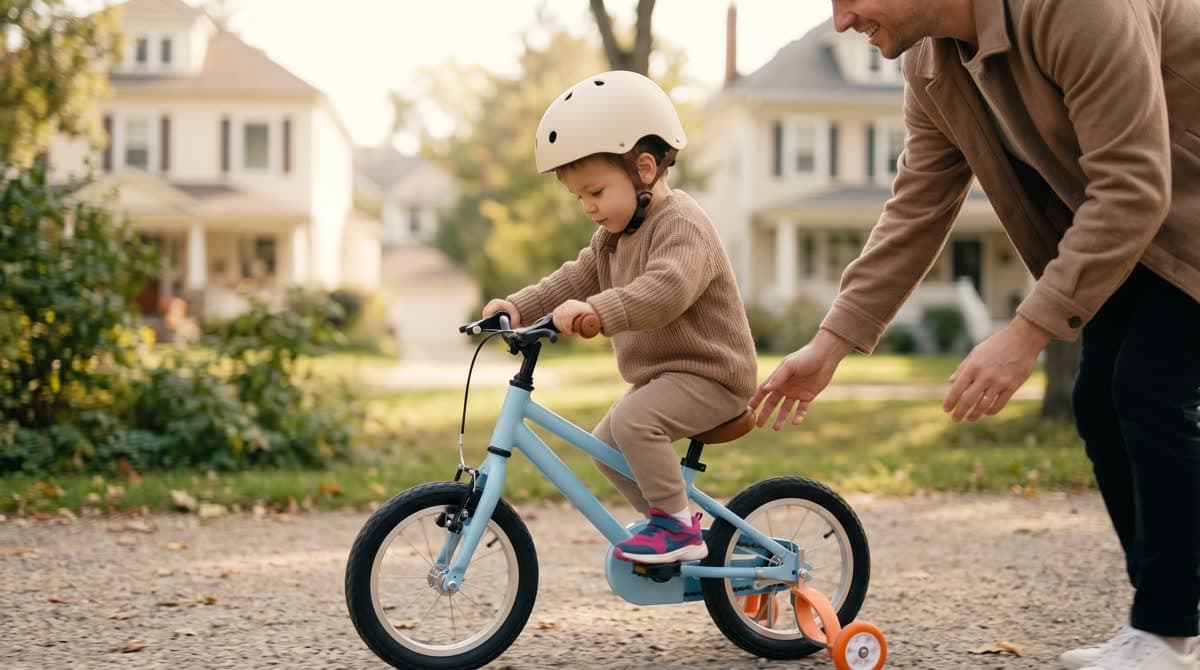
For a 3-year-old measuring between 85 and 100 cm, the 12 inch bike is generally the right choice. At this size, your child can rest their toes on the ground when sitting on the saddle in its lowest position. This is essential: it lets them catch themselves and gives a sense of safety.
Bike weight matters enormously
A 3-year-old weighs on average 14 to 16 kg. A 10 kg bike is therefore over 60% of their body weight, which is huge. The heavier the bike, the harder it is to maneuver and the harder it is to recover from a wobble.
Aim for a bike of 6 to 8 kg max. Aluminum models are lighter than steel ones. The 12-inch Btwin Decathlon bikes, among the most common, weigh between 7 and 9 kg depending on the range.
Essential adjustments
- Saddle height: toes on the ground when your child is seated. Not lower, not higher.
- Handlebars: your child should reach the grips without leaning forward. Check that the steering turns freely.
- Brakes: test that the brake levers are reachable for small hands and that braking is effective.
Progressing step by step: from discovery to independence
Phase 1: Getting friendly with the bike (days 1-7)
Before pedaling at all, your child needs to feel comfortable on the bike. Let them touch it, sit on it, walk alongside it holding the handlebars. Show them how the brakes work. At 3, the familiarization phase shouldn't be rushed.
Phase 2: First pedal strokes (weeks 1-2)
With stabilizers in place, encourage your child to pedal on flat ground. Sessions should be short: 10 to 15 minutes max at this age. A 3-year-old's attention is limited, and fatigue comes quickly. Three 10-minute sessions a week beat one 45-minute session.
Phase 3: Building balance (weeks 2-4)
This is where the type of stabilizer makes a real difference. Classic rigid training wheels stop your child from feeling balance forces. A flexible stabilizer like Baswil lets the bike lean naturally, which activates balance learning while your child pedals.
The advantage at age 3 is huge: your child's brain is in full neural plasticity mode. Balance circuits form quickly when exposed to the right input. A flexible stabilizer provides exactly that input.
Phase 4: Toward independence (weeks 4-8)
Most 3-year-olds using a flexible stabilizer reach enough independence in 4 to 8 weeks. Some get there sooner, others need more time. Pace doesn't matter much: what matters is that your child gradually gains self-confidence and that fun stays at the heart of the experience.
The parent's role: support without steering
At age 3, a child is in an early autonomy phase. They want to do things "all by myself" but still need safety. Your role is to create a reassuring frame without taking control:
- Be present, not intrusive: stay close to reassure, but avoid holding the saddle or steering the bike all the time. Your child has to feel they're acting on their own.
- Name the wins: "You pedaled all the way to the bench, that's farther than yesterday" helps your child measure their progress.
- Normalize the failures: "The bike tilted, that happens. Want to get back on?" beats "Watch out, you're going to fall!"
- Respect refusals: if your child says "no," don't push. Try again tomorrow or in a few days.
- Avoid comparisons: every child has their own developmental rhythm. A child starting at 3 isn't ahead or behind one who starts at 5.
Why start at 3 with a flexible stabilizer
Starting at 3 with a progressive system has a double advantage. First, your child taps into the maximum brain plasticity of this age to internalize balance patterns. Second, they avoid the "unlearning" phase that rigid training wheels create: there's nothing bad to unlearn since the right reflexes form from the start.
To dig further into the question of timing, check our article when to take off training wheels.
Frequently asked questions
Can a child learn to ride a bike at age 3?
Yes, 3 is an ideal age to start cycling. The cerebellum and vestibular system grow rapidly at this age, favouring the learning of balance. A flexible stabiliser lets you use this peak brain plasticity without an abrupt transition later.
What bike size for a 3-year-old child?
A 3-year-old measuring 85 to 100 cm needs a 12 inch bike. Key test: seated on the saddle in its low position, they should place their toes on the ground. A lightweight bike makes control and confidence easier.
Should you start with a balance bike or a bike at age 3?
Both work very well at age 3. A balance bike builds balance alone, a bike with a flexible stabiliser teaches pedalling and balance together. If the child already masters a balance bike, the move to a stabiliser bike is often very fast, sometimes in one session.
How long for a 3-year-old to learn to pedal?
With short, regular sessions, a 3-year-old usually masters pedalling within a few weeks of practice. Prior familiarisation, such as sitting on the saddle, touching the brakes and walking beside the bike, clearly speeds up learning. Patience matters far more than speed at this young age.
My 3-year-old can't pedal, what should I do?
At age 3, this is common and normal. Return to familiarisation: let them sit, push with their feet, understand the brakes without pressure. A flexible stabiliser makes first attempts safer. Favour short 10 to 15 minute sessions and praise every small step.
What safety gear for a 3-year-old on a bike?
A helmet fitted to the EN 1078 standard is essential, placed flat two fingers above the eyebrows with the chin strap snug. Add knee pads and choose flat, smooth, traffic-free ground. Safety directly shapes a young child's confidence and enjoyment.
What is the parents' role in learning at age 3?
At age 3, the child wants to do it alone but needs safety. Create a reassuring framework without taking control: support without constantly holding the saddle, encourage effort and respect their pace. A flexible stabiliser allows this gradual independence safely.
Why use a flexible stabiliser rather than training wheels at age 3?
A flexible stabiliser lets the bike lean, so the child integrates balance from the start. It avoids the unlearning phase for bad reflexes created by rigid training wheels. At age 3, brain plasticity makes this learning especially effective and lasting.
Baswil: the first bike, well supported
The Baswil flexible stabilizer fits 12 to 16 inch bikes, including Btwin Decathlon. Designed for kids ages 3 to 6, it offers a natural transition to riding without training wheels. €52, 5-minute installation, 30-day money-back guarantee.
Shop Baswil