The balance bike: balance first
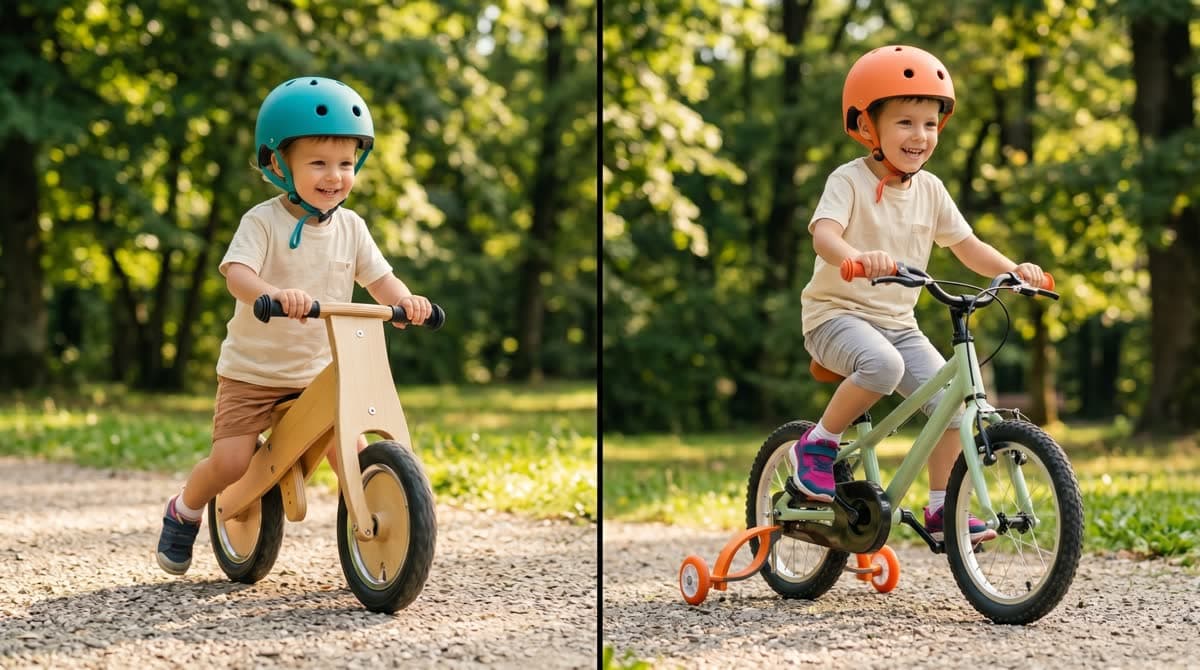
A balance bike is a bike without pedals that the child moves by pushing off the ground with their feet. The concept, invented in the 19th century, has made a strong comeback over the last fifteen years. Its principle is simple: learn balance before pedaling.
How it works on a motor level
On a balance bike, your child discovers what lateral lean feels like and learns to correct their path through micro-adjustments of the handlebars and body weight. Motor skills develop naturally: they start by walking while holding the handlebars, then glide for longer and longer between foot pushes.
The advantages
- Suitable from 18 months to 2 years for adapted models.
- Develops balance in an intuitive way.
- Light, easy to carry and often inexpensive.
- No risk of becoming dependent on training wheels.
The limits
- Doesn't teach pedaling. Moving to a pedal bike is still a step to take.
- Some children pick up bad postural habits (feet dragging on the ground once on a regular bike).
- Not great after age 4: the child is often too big and wants "a real bike."
- Requires buying a second bike (with pedals) for what comes next.
Training wheels: pedaling first
Training wheels (also called stabilizer wheels) are the traditional system. Two extra wheels mounted on each side of the rear wheel keep the bike from tipping. Your child learns to pedal in a fully stable environment.
How it works on a motor level
With rigid training wheels, the bike can't lean. Your child pedals without ever feeling the lateral balance forces. They learn the circular leg motion, braking and steering, but not balance itself.
The advantages
- Your child pedals from day one. Instant gratification.
- Compatible with the bike they'll keep using afterward.
- Reassuring for both parents and child.
- Low cost and simple to install.
The limits
- Delays balance learning: the child leans on them instead of building their reflexes.
- The removal often comes as a shock: an abrupt jump from 4 to 2 contact points.
- Creates a false sense of ease: the child thinks they're confident even though they've never worked on balance.
- In turns, rigid training wheels can cause dangerous tipping.
The third way: combining pedaling and balance
What if you could learn to pedal AND develop balance at the same time? That's the principle behind the flexible stabilizer. Unlike rigid training wheels, a flexible stabilizer like Baswil lets the bike lean naturally. The stabilizing wheels only touch the ground when the lean exceeds a certain angle, acting as a safety net rather than permanent crutches.
This approach solves the limits of both classic methods. Your child pedals (like with training wheels) but feels the balance sensations (like on a balance bike). There's no abrupt transition to manage, since balance develops progressively while your child rides.
For a deeper look at how this approach works, check out our how it works page.
Expert test
After a few days it really unlocked pedalling for my son. We were able to take the wheels off and it worked well.
Aurélien Fontenoy
Three-time MTB trials world silver medallist
Test carried out in partnership with Baswil.
Which solution by age and situation
| Situation | Recommendation |
|---|---|
| Child aged 18 months to 2.5 years | Balance bike: too young to pedal, balance comes naturally. |
| Child aged 3 to 4, first pedal bike | Flexible stabilizer (Baswil): learns to pedal and balance at the same time. |
| Child aged 4 to 6, stuck with rigid training wheels | Replace the training wheels with a flexible stabilizer to unlock balance. |
| Confident child who has already used a balance bike | Direct move to a bike without training wheels, or a flexible stabilizer to secure the first few days. |
The real question: is your child progressing?
Whatever method you choose, the central question stays the same: is your child gaining confidence and independence with each session? If yes, you're on the right track. If not, it might be time to switch approaches.
To gauge when your child is ready to ride without help, look for concrete signs of readiness rather than the age printed on the box.
Frequently asked questions
Balance bike or training wheels: which to choose?
A balance bike builds balance first, training wheels build pedalling first. The balance bike prepares better for a two-wheeler because balance is the key skill. A flexible stabiliser combines both: the child pedals and balances at the same time.
Is a balance bike really more effective than training wheels?
Yes, clearly, for learning balance. A balance bike works the sense of balance from the start, without creating bad reflexes to correct later. Rigid training wheels delay this learning because the child leans on them instead of actively seeking balance.
From what age can you use a balance bike?
A balance bike can be used from 18 months to 2 years, as soon as the child walks well. The frame size should let the child place both feet flat on the ground while seated on the saddle. Most children master it between ages 2 and 4.
Do training wheels delay learning to ride a bike?
Yes, rigid training wheels can delay balance because the child leans on them constantly and never learns to rebalance alone. Once removed, they must unlearn that reflex. A flexible stabiliser avoids this by allowing the bike's natural lean in corners.
Can you go straight from a balance bike to a bike without stabilisers?
Yes, frequently. A child comfortable on a balance bike has already acquired balance, the hardest skill. They only need to learn pedalling, which often happens in a few sessions, sometimes just one, without using training wheels at all.
What is a flexible stabiliser and how does it work?
A flexible stabiliser replaces rigid training wheels with a system that lets the bike lean naturally in corners. The child pedals safely while working on balance. Support reduces gradually as progress is made, with no abrupt transition at the end.
Which solution to choose for the child's age?
Before age 3, a balance bike suits best. From 3 to 6, a flexible stabiliser lets the child learn pedalling and balance at the same time on a 12 to 16 inch bike. Classic training wheels remain an option but slow real independence.
How long before my child rides alone?
With a flexible stabiliser, results are visible within 2 to 4 weeks of regular sessions. With a balance bike followed by a bike, the move to independence is often fast. The real indicator stays progress: is the child gaining confidence each session?
Baswil: the best of both worlds
Compatible with compatible 12 to 16 inch bikes (including Btwin Decathlon), Baswil installs in a few minutes in place of classic training wheels. At €52, your child learns to pedal and balance at the same time. Visible results in 2 to 4 weeks.
Shop Baswil