The right size: height and inseam
Kids' bike size isn't picked by age but by body proportions. Two measurements drive the choice:
- Your child's height: a 14-incher fits roughly 90 to 105 cm
- Inseam: this is the deciding measurement. The inseam should be at least equal to the bike's minimum saddle height. For a 14-incher, count on an inseam of 38 to 48 cm.
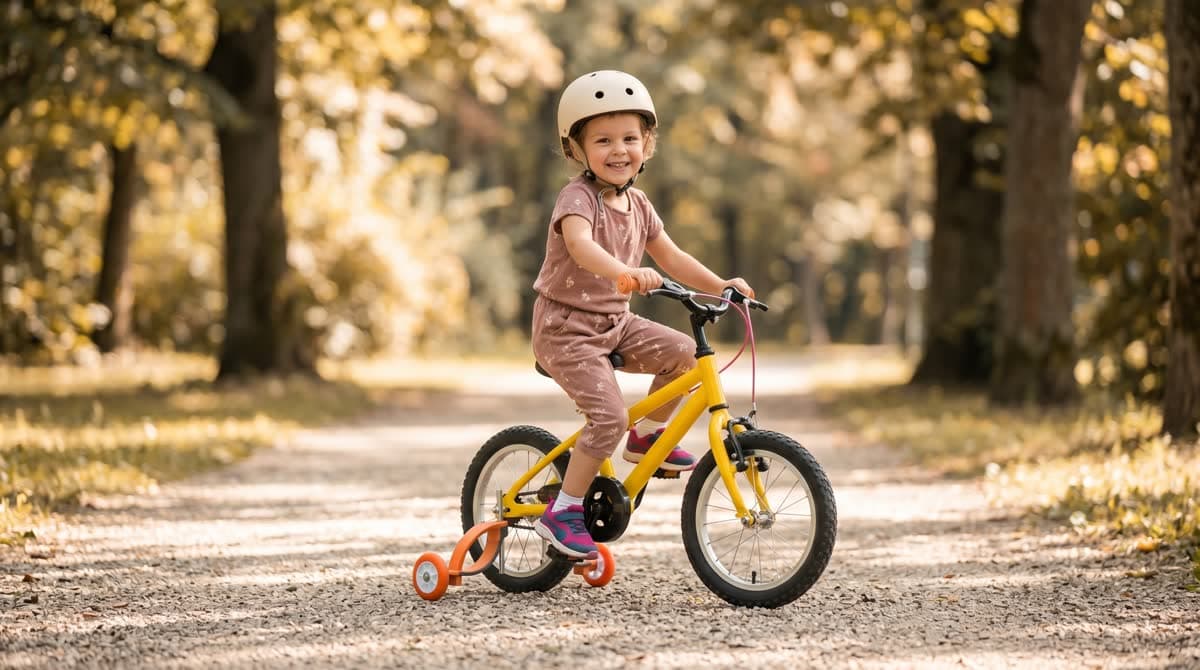
In practice, your child seated on the saddle (set to its lowest) should be able to plant both feet flat on the ground. On tiptoes? The bike is too big. Knees deeply bent? Too small.
Resist the urge to buy "a bit bigger so it lasts longer." A bike that's too big is dangerous and discouraging. For 3-year-olds just starting out, see our complete guide to learning at age 3.
Bike weight: the underrated criterion
Bike weight is probably the factor parents overlook most and the one that matters most to the child. A 10 kg bike for a 15 kg child is like a 75 kg adult having to handle a 50 kg bike.
Targets to aim for on a 14-incher:
- Under 7 kg: excellent, dramatically eases learning
- 7 to 8.5 kg: fine, this is the range of most quality bikes
- Over 9 kg: heavy for a child, can slow progress
An aluminum frame significantly cuts weight versus steel. It's an investment that pays off on a first bike.
Brakes: which system to favor?
Three brake systems exist on 14-inch bikes:
- Coaster brake: your child brakes by pedaling backward. Intuitive for some, confusing for others. Common on entry-level models.
- V-brakes (hand brakes): levers on the handlebars. Requires enough hand strength. Check that your child can actually pull them.
- Both combined: the ideal setup, giving your child two braking options.
Whichever system, test in store that your child can physically use the brake. Levers that are too far or too stiff are useless and dangerous.
Other things to check
- Chain guard: a closed guard protects fingers and clothes. Essential at this age.
- Reflectors and lights: required on public roads, often missing on new bikes sold online.
- Steering limiter: some models include one to prevent falls caused by handlebars turning 90 degrees.
- Kickstand: optional but handy. Your child learns to park their bike properly.
A look at popular models
Here are the 14-inch models you'll see most in 2026, with their strong points:
- Btwin 500 (Decathlon): the value benchmark. Steel frame, around 8 kg, coaster brake + front V-brake. Wide availability and easy-to-find parts.
- Btwin 900 (Decathlon): lightened version with aluminum frame, under 7.5 kg. Better for learning thanks to the reduced weight.
- Woom 2: high-end reference, around 5 kg. Geometry optimized for kids, adapted components. Higher price but remarkable quality.
- Early Rider Belter: light aluminum frame, belt drive (silent, grease-free). Around 5.5 kg.
- Puky ZL 14: a respected German brand, low frame for easy mounting, solid overall ergonomics. Around 8 kg.
Outfitting the bike: helmet and stabilizers
A helmet is required in France for cycling children under 12. Choose an EN 1078 certified model, well fitted (it shouldn't shift or pinch).
For learning, the question of stabilizers always comes up. If you go with a support system, favor a stabilizer that allows active balance learning over rigid training wheels that block it. Our article Btwin Decathlon training wheels: compatibility and alternatives details the available options.
Baswil compatibility with 14-inch bikes
Baswil is designed for 12–16 inch children’s bikes. Compatibility depends on the rear axle mounting point, not just the brand or wheel size. Check the guide before buying; if unsure, contact us with the model and a photo of the rear axle.
Installation requires no bike modification and takes a few minutes. Baswil mounts on the rear wheel axle, exactly like classic training wheels, but works in a radically different way thanks to its flexible blades.
Frequently asked questions
What age is a 14 inch kids' bike suitable for?
A 14 inch bike generally suits children aged 3 to 5, measuring between 90 and 105 cm. It is often the first real pedal bike. However, size is chosen by build and inside-leg measurement, not by the child's age alone.
How do you check a 14 inch bike is the right size?
Seated on the saddle set at its lowest, the child should place both feet flat on the ground. If on tiptoes, the bike is too big. If knees are very bent, it is already too small. Count an inside leg of 38 to 48 cm.
What is the ideal weight for a 14 inch kids' bike?
Aim for under 7 kg to greatly ease learning. A range of 7 to 8.5 kg stays fine and covers most quality bikes. Above 9 kg, the bike is heavy for a child and can slow progress. An aluminium frame lightens it significantly.
Should you buy a bigger 14 inch bike so it lasts?
No. A bike that is too big is dangerous and discouraging: the child can neither put their feet on the ground nor control it calmly. Choose the size suited to their current build, then a progressive system rather than rigid wheels so learning and confidence come first.
Which brake system to favour on a 14 inch bike?
The coaster brake plus hand brakes combination is ideal, offering two braking options. Whatever the system, test in store that the child can physically pull the lever. Levers too far away or too stiff are useless and dangerous at this age.
Which 14 inch bike models are popular in 2026?
The Btwin 500 Decathlon offers the best value, about 8 kg. The lightened Btwin 900 drops below 7.5 kg in an aluminium frame. The Woom 2 and Early Rider Belter, around 5 to 5.5 kg, are top-end references ideal for learning.
What gear should you check on a 14 inch kids' bike?
Check for a closed chain guard protecting fingers and clothes, reflectors and lights required on public roads, a possible steering limiter and a kickstand. Add a helmet meeting the EN 1078 standard, well fitted and presented as normal gear.
Is the Baswil stabiliser compatible with a 14 inch bike?
Baswil is designed for 12–16 inch children’s bikes. Compatibility depends on the rear axle mounting point, not just the brand or wheel size. Check the guide before buying; if unsure, contact us with the model and a photo of the rear axle.
A well-chosen bike + the right stabilizer
A 14-inch bike sized for your child, paired with the Baswil flexible stabilizer, makes the ideal duo for confident learning. Your child develops balance naturally, without the rupture of removing training wheels.
Baswil: €52, compatible with 12-16 inch bikes, 5-minute installation.