
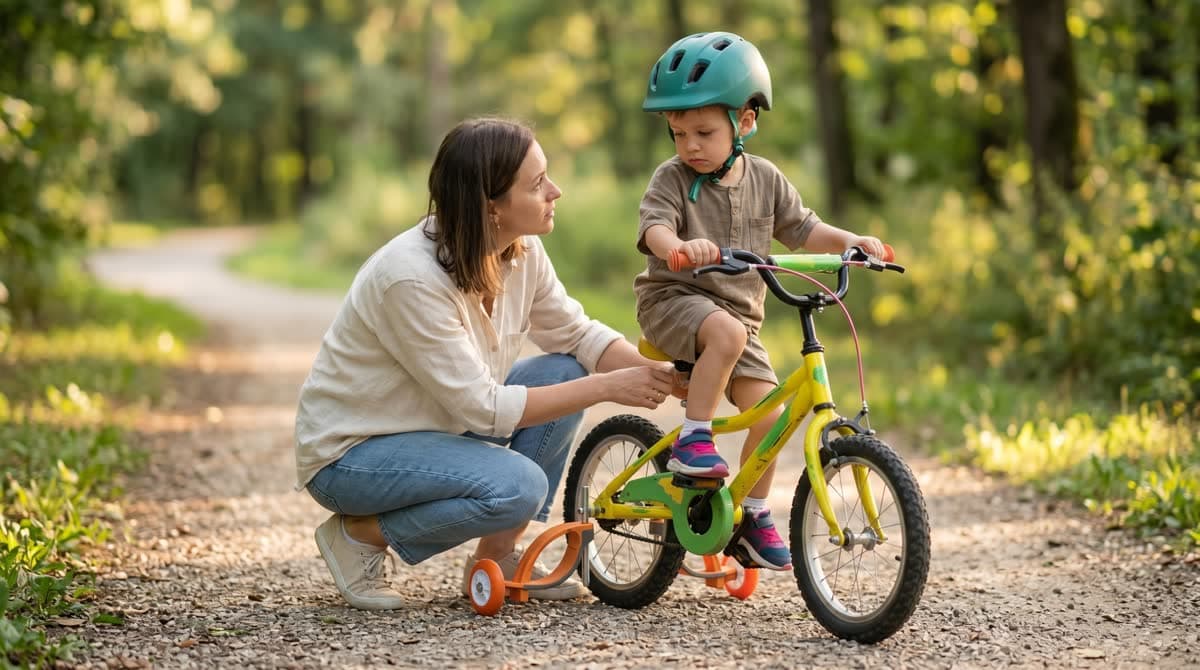
Mistake #1: a bike that's too big "so it lasts"
This is the most common and most damaging mistake. Buying a bike that's too big to save money ends up compromising months of learning. A child whose feet don't reach the ground flat can't catch themselves when they wobble. They know it instinctively, and that insecurity creates fear.
The consequences cascade: fear, refusal to get on the bike, stagnation, parental frustration that pushes harder, lasting blockage. All of that to save on one bike purchase.
The right approach: choose a bike sized for your child today. Seated on the saddle at the lowest setting, both feet should plant flat on the ground. Kids' bikes resell easily second-hand, so it's not a waste. Progress depends on it directly.
Mistake #2: training wheels set too low
When both training wheels touch the ground all the time, the bike never leans. Your child pedals, steers, brakes, but doesn't learn balance. That's the training-wheel paradox: they create the impression that your child "knows how to ride" when they've only built part of the necessary skills.
Then comes removal day. The child who seemed so comfortable can't hold balance for 3 seconds. The disappointment matches the expectation.
The right approach: if you use classic training wheels, set them 5-10 mm above the ground to allow a slight lean. But even with the right setting, the underlying issue remains: support is binary (all or nothing) instead of progressive. That's why a flexible stabilizer offers a structural advantage for balance learning.
Mistake #3: pushing a child who isn't ready
"Come on, try, it's not hard." "Your cousin already knew at your age." "No taking off the helmet until you've done three laps." That kind of pressure, even mild, produces the opposite of what you want. A child you force associates cycling with an obligation, not a pleasure.
Patience isn't passive. It means offering regularly without imposing, being available without being insistent, and accepting that a 3-year-old who refuses today might be enthusiastic in three weeks.
The right approach: make the bike accessible (visible, within reach) and let your child come to it on their own. Offer short sessions (10-15 minutes) without performance goals. Autonomy over the decision is the first driver of motivation. For a child showing signs of fear, see our article on the right age to take off training wheels.
Mistake #4: removing stabilizers all at once
Classic scenario: your child rides well with training wheels, you decide to take them off one Saturday morning, and your child literally collapses. Fall, tears, flat refusal to get back on. The parent is surprised, the child is shaken.
The problem isn't the removal itself, it's the lack of transition. Going from "full support" to "no support" in a second is abrupt. It's like pulling water wings off a child mid-pool.
The right approach: plan a progressive transition. If you use classic training wheels, raise them by a few millimeters each week to gradually expand the lean zone. Or better: use a system designed for progression. Our guide removing training wheels without stress details a 4-step method.
Mistake #5: choosing the wrong terrain
Tall grass, gravel, slope, narrow sidewalk with passersby: terrain can turn a learning session into a survival test. Grass seems soft if your child falls, but it requires far more pedaling effort and the training wheels sink into it. Gravel is unstable. A slope adds a speed variable your child can't yet manage.
The right approach: hard, flat and smooth ground (empty parking lot, paved yard, flat bike path) is the ideal terrain. The over-protection instinct that pushes you toward grass "just in case" is counterproductive: it makes learning harder and slower. Save varied surfaces for when your child already has basic balance down.
The positive approach in summary
These 5 mistakes share one thing: they come from good intentions. Buying big to save, protecting with low-set training wheels, encouraging by insisting, removing the help when it seems acquired, picking soft ground to cushion. Adult logic just isn't aligned with what learning actually needs.
The right stance combines:
- A bike sized for today
- A progressive (not binary) support system
- Patience and offers without pressure
- A graduated transition, never abrupt
- Terrain suited to learning
For any other questions about teaching your child to ride, check our FAQ.
Frequently asked questions
What mistakes delay learning to ride a bike?
Five mistakes slow progress: buying a bike that is too big, setting training wheels too low, forcing a child who is not ready, removing stabilisers all at once and choosing poor ground. All stem from good intentions poorly aligned with real needs.
Why not buy a bigger bike so it lasts?
A bike that is too big undermines months of learning. A child who cannot place their feet flat cannot recover from imbalance, which creates fear and refusal. Choose a bike for their current size: kids' bikes resell very well second-hand.
How do you know if a bike is the right size?
Seated on the saddle set at its lowest, the child should place both feet flat on the ground. This position lets them recover instinctively from imbalance and feel safe, a vital condition for learning without fear or lasting blocks.
Should you force a child who does not want to ride a bike?
No, forcing a child has the opposite effect: they link the bike to an obligation, not to pleasure. Make the bike accessible and visible, offer short 10 to 15 minute sessions with no performance goal, and let the child come of their own accord.
Why not remove stabilisers all at once?
Removing stabilisers all at once goes from full support to none in a second, like taking off armbands mid-pool. The child falls, cries and refuses to get back on. A flexible stabiliser with springy blades creates precisely the progressive transition missing between the two states.
What is the best ground for learning to ride a bike?
Hard, flat, smooth ground is ideal: an empty car park, a tarmac yard or a flat cycle path. Avoid grass, which demands more pedalling effort and where training wheels sink, unstable gravel and slopes that add speed the child cannot manage.
Why is choosing grass to cushion falls a mistake?
Grass seems soft but actually makes learning harder and slower for the child. It demands far more pedalling effort and the training wheels sink into it. This overprotection is counterproductive: save varied surfaces for when the child already masters basic balance.
What parental attitude favours learning to ride a bike?
Combine five elements: a bike suited to the current size, a progressive rather than binary support system, patience without pressure, a graded transition that is never abrupt, and hard, flat, smooth ground. A flexible stabiliser with springy blades fulfils this progressive support role.
Avoid these mistakes with the right tool
The Baswil stabilizer was designed to eliminate the issues tied to classic training wheels. Its flexible blades offer progressive support that accompanies learning instead of blocking it. No height adjustment, no abrupt transition, no false sense of mastery.
Compatible with 12-16 inch bikes (including Btwin Decathlon). €52. 5-minute installation.