
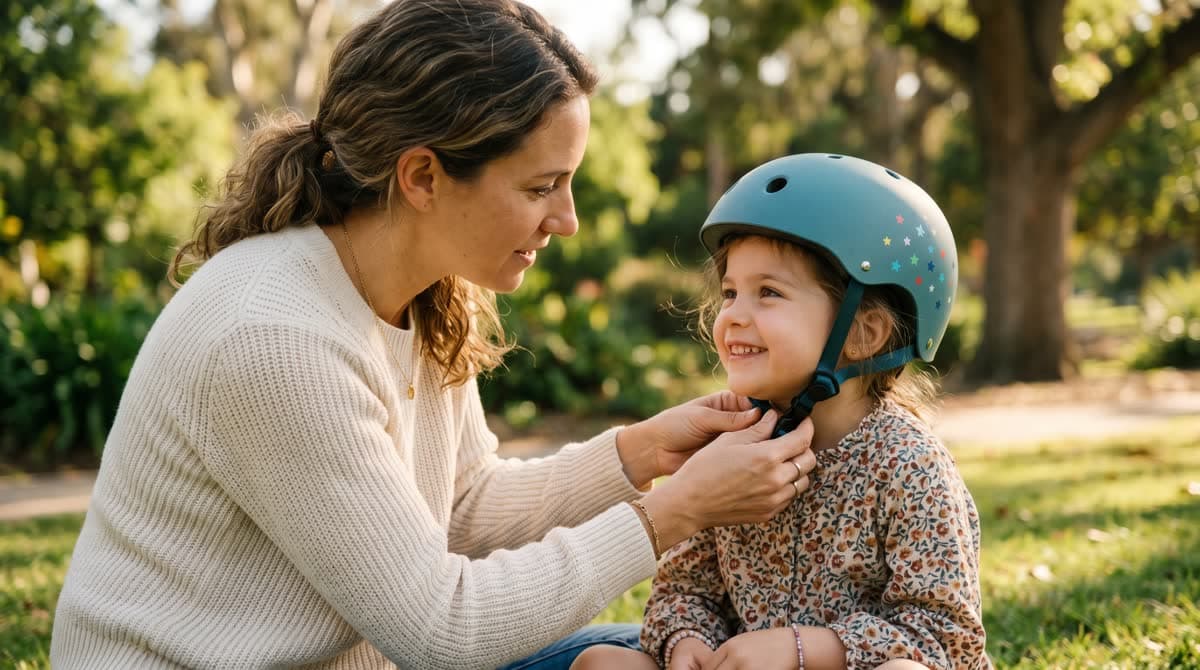
Bike helmet: rules and fit
The helmet is the non-negotiable item of kids' kit. A fall at 8 km/h on tarmac generates impact enough to cause concussion without protection. Beyond legislation, it's the single piece of gear that drastically reduces the risk of serious injury.
United Kingdom: not legally required, strongly recommended
In the UK, helmet use is not a legal requirement for cyclists, including children — except for organised events (BC-licensed races, sportives, some cycling schools). The Highway Code (rule 59) and ROSPA strongly recommend it. In practice, the vast majority of UK schools that run Bikeability courses require a helmet during sessions.
France: helmet mandatory for under-12s
In France, decree no. 2016-1800 of 21 December 2016 (in force since 22 March 2017) makes helmet wearing mandatory for any child under 12, whether riding or as a passenger. The fine for the supervising adult is €135. The rule applies everywhere: public roads, cycle paths, parks, even private courtyards if the bike is in use.
Belgium and Luxembourg: not mandatory but recommended
In Belgium and Luxembourg, helmet use is <strong>not legally required</strong>, neither for children nor adults. Vias institute (formerly IBSR, Belgium) and the Sécurité Routière (Luxembourg) strongly recommend it, especially for young children. Most schools that organise a cycling proficiency badge require helmets during sessions.
EN 1078: the European minimum standard
Any helmet sold in the EU and UK must carry the CE EN 1078 marking (or post-Brexit UKCA equivalent in the UK). The standard guarantees impact absorption, strap strength and helmet stability on the head. Be wary of novelty helmets bought abroad or on marketplaces: without EN 1078 marking, there's no impact-absorption guarantee. A certified children's helmet starts around €25 (£22).
Fit: the 2-V-1 method
A poorly fitted helmet is half as effective. The 2-V-1 method gives a reliable fit in 30 seconds:
- 2 fingers between the child's brow and the front rim of the helmet (no higher, no lower).
- Straps form a V around each ear, without covering it.
- 1 finger only fits under the closed chinstrap. No more, or the helmet shifts on impact.
Check the fit before every ride: children grow fast and the inner foam compresses. A helmet should be replaced after any significant impact, even with no visible crack — the absorbing foam loses its properties with use.
Full kit: what to plan for
Beyond the helmet, several items reduce injury risk and improve visibility. Full list:
- CE EN 1078 helmet: fitted by the 2-V-1 method above.
- Kids' cycling gloves: protect the palms in a fall, since hands instinctively go out to break a fall. Essential on tarmac.
- Hi-vis vest: required in several countries on rural roads with reduced visibility. Very useful for family rides at dusk.
- Bell: a regulatory item across the EU and UK, and educationally useful — the child learns to alert pedestrians.
- Front and rear lights: white at the front, red at the rear. Required after dark. Prefer USB-rechargeable clip-on models.
- Knee and elbow pads (optional): useful for the first hours of learning, particularly on tarmac. Many children feel more reassured and try more.
- Closed-toe shoes: ban sandals and flip-flops. A flat-soled trainer offers better grip on the pedals.
A full kit budget for a 4-7-year-old runs around €60-90 (helmet, gloves, vest, lights), a modest investment compared to the bike itself. For a gift that combines bike and kit, see our kids' bike gift guide.
Choosing the right learning ground
Terrain directly influences progress and safety. Many early-metres falls come from poor surface choice, not lack of balance.
The empty car park: the ideal ground
An empty car park on a Sunday morning ticks every box: flat, smooth surface, open space without feeling hemmed in, painted lines to follow, no traffic. Shopping centre, gym and school car parks are often accessible to families at weekends.
Park paths
A wide, lightly used asphalted path in a public park works well. Avoid packed-earth tracks: their irregular surface complicates balance. Grass looks soft but offers resistance that discourages those first turns of the pedals.
Cycle paths
Reserve cycle paths for children who already master balance and braking (typically after the first 5-10 hours of practice). Sharing space with faster adult cyclists requires a minimum of control. A cycle path separated from the road, looping through a park, is the safest option.
Surfaces to avoid
Three surfaces complicate learning needlessly: slopes (speed amplifies fear and reduces control), gravel (unstable, guaranteed slips), and grass (excessive resistance, the bike halts despite pedalling). Pavement edges, even wide ones, add the risk of falling into the road — best avoided during learning.
The bike itself: kit and stability
The child's gear isn't enough on its own: the bike must itself be suited and properly set up. A bike that's too big, brakes too stiff, or an unsuitable stabiliser system multiply the risk of falls.
Three points to check:
- Right size: seated on the saddle, the child must put both feet flat on the ground. See our size by age guide for the right reference.
- Child-friendly brakes: levers must be reachable by small hands and operable without excessive force. Many entry-level bikes have brakes too stiff for a 4-5-year-old.
- Flexible stabiliser system: a Baswil flexible stabiliser replaces rigid training wheels and supports balance learning without the dangerous lateral tip-overs seen with classic stabilisers in turns.
A well-equipped bike actively prevents falls. The best helmet in the world doesn't fix a bike that's too big or brakes that don't work. Safety begins with suitable kit.
The 3 fundamental rules to teach
Even before leaving the practice car park, three simple rules must become automatic. Repeat them every ride for the first weeks.
Rule 1: Look
Always look where you're going, never at your feet. Beginner children tend to stare at the pedals or the front wheel. Parent demo: ride alongside, point at a distant object (a tree, a sign), and ask them to fix on it. The line of travel becomes instantly straighter. Extend the rule to junctions: look left, right, then left again before crossing.
Rule 2: Signal
Extend the arm to signal a change of direction. Left arm out for left turn, right arm out for right turn. For very young children who can't yet ride one-handed, practise it stationary: train arm-raising while pedalling slowly, parent alongside. It's a skill that takes weeks but saves real situations.
Rule 3: Brake
Always brake with both brakes together, gently and progressively. Many children use only one lever or brake hard and lock the wheels. Demo: very gentle descent of a dropped kerb, ask them to slow progressively before the end. Insist on front AND rear brake together. Once mastered, the child gains autonomy and safety.
What to do in a fall
A fall during learning is almost inevitable. Your reaction as a parent largely shapes what happens next. Four steps in order:
- Check: stay calm and approach without rushing. Before lifting the child, check for heavy bleeding, visible deformity (wrist, collarbone), or loss of consciousness. In 95% of cases, it's minor grazes.
- Reassure: your tone matters more than your words. A calm "it's OK, you've had a fright" is worth a thousand cries or dramatics. Don't minimise either ("it's nothing, come on!"): acknowledge the fear, it's legitimate.
- Treat: clean grazes with clean water (ideally at home), apply mild antiseptic then a plaster. A minimal first-aid kit (gauze, saline, plasters) fits in a bag.
- Get back on (if possible): if the fall is minor, suggest getting straight back on the bike, even just for 10 metres. This "resume" prevents lasting fear taking root. If the child firmly refuses, don't insist — try again the next day.
For a child who develops persistent fear after a fall, see our article child afraid after a fall. Bike fear is treated through very gradual progression and a reassuring environment.
Country-by-country: UK / FR / BE / LU
Traffic rules and required kit vary by country. Practical summary for cross-border families.
United Kingdom
Helmet not legally required, strongly recommended (Highway Code rule 59). Required for organised events (BC-licensed races, sportives). Front white light, rear red light and rear reflector mandatory between sunset and sunrise (Road Vehicles Lighting Regulations 1989). Bell required at point of sale but not legally required to be fitted. Children may ride on the pavement in practice (no specific age cut-off in law for under-10s in most areas, but discretion applies); cycle on cycle paths or roads from age 10+.
France
Helmet mandatory for under-12s (€135 fine). Hi-vis retro-reflective vest mandatory outside built-up areas in reduced visibility (night, fog, heavy rain) for any cyclist, including children. Front and rear lights required at night. Bell mandatory. Pavement riding tolerated for children up to 8 years old, at walking pace.
Belgium and Luxembourg
Helmet not legally required but strongly recommended. <strong>Hi-vis vest and front/rear lights required at night</strong> or in poor visibility. Bell mandatory. In Belgium, pavement riding is forbidden except for accompanied children under 9. In Luxembourg, accompanied children under 10 may use the pavement.
Across all four countries, remember the practical rule: helmet + vest + lights as soon as you leave the practice car park. Easier to remember than the regulatory nuances.
The 6-point ride check-list
Before each ride, mentally or aloud with your child, run through these 6 points. In 30 seconds you eliminate most avoidable risks.
- Helmet fitted by the 2-V-1 method (2 fingers, V, 1 finger).
- Bike checked: tyre pressure, brakes responsive, chain in place, saddle height correct.
- Vest and lights appropriate to weather and time (reduced visibility = required in most cases).
- Suitable weather: no learning sessions in rain or strong wind. For a family ride, just check it won't rain on the way home.
- Route checked: where are we going, how long, what junctions? A familiar route reassures the child.
- Water and a snack: a child pedalling for 30 minutes needs to drink. A bottle in the bag prevents abrupt stops.
Print this list and pin it in the garage next to the bikes for the first months. After 10 rides, the reflex is built in.
Frequent parent questions
Is a bike helmet legally required for children?
In the UK, no — helmet use isn't legally required for children, but it's strongly recommended by the Highway Code and ROSPA, and required for organised events. In France, yes: since 2017, helmets are mandatory for any child under 12, riding or as passenger, with a €135 fine for the supervising adult. In Belgium and Luxembourg, helmets are not legally required but strongly recommended.
Is the bike helmet mandatory in the UK?
No, helmet wearing isn't legally mandatory in the UK for cyclists of any age. It's strongly recommended by ROSPA, the Highway Code (rule 59) and most cycling organisations, particularly for children. Bikeability courses and most BC-affiliated events require helmets.
What's the minimum kit for a child on a bike?
Bare minimum: CE EN 1078 helmet properly fitted, bell, white front and red rear lights after dark, hi-vis vest in reduced visibility outside built-up areas, and closed-toe shoes. Gloves and pads are strongly recommended during learning but not legally required.
Can a child ride on the pavement?
In the UK, in practice yes for younger children (no statutory age in most areas, though strict reading of the law forbids cycling on pavement; police generally exercise discretion for under-10s). In France, yes up to age 8, at walking pace. In Belgium, up to age 9 with accompaniment. In Luxembourg, up to age 10 with accompaniment. Beyond these ages, the child should use the road or cycle path.
From what age can a child ride alone on the road?
There's no single legal age, but most road safety bodies recommend 10-11 for quiet roads and 13-14 for urban traffic. The Bikeability Level 2/3 (UK) or the cycling proficiency badge (FR/BE) validates the necessary skills, typically taken in upper primary school.
How do you fit a child's bike helmet?
2-V-1 method in 30 seconds: 2 fingers between brow and front rim, straps form a V around each ear, and 1 finger only fits under the closed chinstrap. Check before every ride. Replace the helmet after any significant impact, even with no visible crack.
Should I buy knee pads for learning to ride?
Not essential but useful during the first hours of learning, particularly on tarmac. Knee and elbow pads reassure the child and limit grazes that could discourage them. Many parents use them for the first 2-4 weeks then drop them once confidence is built.
Where to learn to cycle safely?
An empty car park on a Sunday morning is ideal: smooth surface, open space, no traffic. A school playground during holidays, an asphalted park path or a quiet cycle path also work. Avoid slopes, gravel and grass for the first hours.
What if my child falls off?
4 steps: check (bleeding, deformity, loss of consciousness), reassure (calm tone, acknowledge the fear), treat (clean water, antiseptic, plaster), and suggest getting back on for even 10 metres if the fall is minor. For lasting fear, see our dedicated guide.
How do you teach safety rules to a child?
By repetition and demonstration, not lecturing. Ride alongside, calling out and applying the 3 fundamental rules: look ahead, signal with the arm, brake with both brakes together. The Bikeability programme (UK) or the cycling proficiency badge in primary school reinforces these reflexes. Our how it works page also explains how Baswil secures the learning phase.