
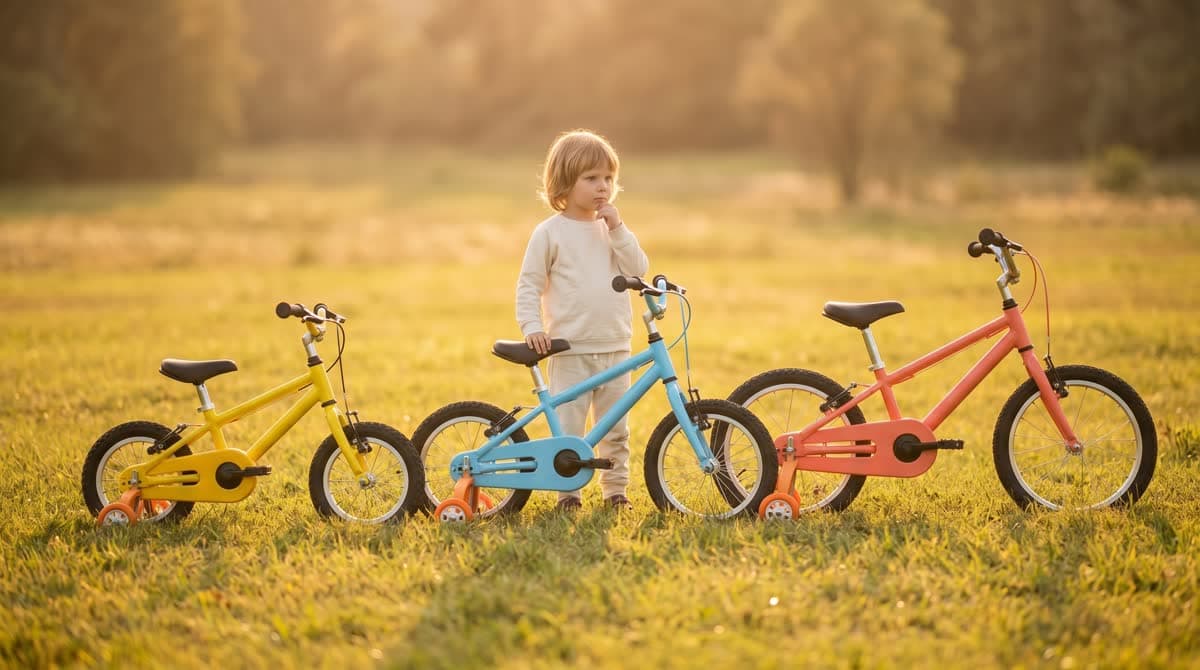
Size chart by age
The right kids' bike isn't chosen by age but by height and especially inseam. This chart gives the reference correspondences used by specialist makers (Btwin, Woom, Puky, Frog) in 2026.
| Age | Child height | Inseam | Wheels | Min saddle height |
|---|---|---|---|---|
| 2-3 years | 85-100 cm | 33-38 cm | 12" | 38-42 cm |
| 3-4 years | 95-110 cm | 38-43 cm | 14" | 43-49 cm |
| 4-6 years | 105-120 cm | 43-50 cm | 16" | 49-56 cm |
| 5-8 years | 115-135 cm | 50-58 cm | 20" | 56-65 cm |
| 7-10 years | 125-145 cm | 58-65 cm | 24" | 65-73 cm |
The bands deliberately overlap: a 4-year-old can be comfortable on a 14" or a 16" depending on body shape. Golden rule: it's always inseam that decides, never age.
For 14-inch bikes specifically, see our detailed guide: which 14-inch bike to choose.
Inches or centimetres: understanding the units
Kids' bikes are measured in inches rather than centimetres. The convention comes from the Anglo-Saxon roots of the modern bicycle and persists for international interoperability. One inch is 2.54 cm.
The figure refers to the outer wheel diameter (rim plus tyre), not the frame size as on adult bikes. Useful conversions:
- 12 inch = about 30.5 cm wheel diameter
- 14 inch = about 35.5 cm
- 16 inch = about 40.5 cm
- 20 inch = about 50.8 cm
- 24 inch = about 61 cm
Why the wheel diameter? Because on a kids' bike, that's what dictates the overall bike height and so the fit with the child's leg length. The frame then follows fixed proportions tied to wheel size. It's different from adult bikes, where you talk in cm of horizontal top tube (S, M, L, XL).
From 26 inches, you switch to adult standards. A 24 inch is the last "kids'" bike before the move to a small-frame adult bike.
Measuring inseam in 4 steps
Inseam is the most reliable measure for choosing bike size. It's the inside-leg length, from floor to crotch. Here's the method used by professional bike shops:
- Stand your child barefoot, back against a wall, legs straight and together.
- Place a thick book between their legs, spine up, and ease it firmly into the crotch (like a saddle). The book must be horizontal and pressed firmly, as if they were sitting on it.
- Mark on the wall with a pencil the point where the spine of the book meets it, horizontally.
- Measure the distance from the floor to the mark, in centimetres. That's your child's inseam.
This figure must be at least equal to the minimum saddle height of the bike you're considering (column 5 of the chart). If the inseam is lower, the child won't reach the ground and the bike is too big.
Re-measure every 6 months between ages 2 and 8: a child can grow 5-8 cm a year, and legs grow faster than the torso at these ages. To set the position properly once the bike is chosen, see our guide set training wheel height.
Child between two sizes: which to pick?
It's the most common situation: your child sits in the overlap between two wheel sizes. For example, at 4 years old with a 43 cm inseam, they're at the top of 14 inch and the bottom of 16 inch. What to do?
Absolute rule: feet must touch the ground. When the child sits on the saddle at the lowest setting, both feet must be flat on the ground, heels included. If they're on tiptoes, the bike is already too big.
When in doubt, always choose the smaller size. Here's why:
- Immediate safety: the child can catch themselves on the ground if they wobble, preventing the most dangerous falls.
- Confidence preserved: a bike that's too big creates fear, even in a competent child. Fear delays learning by months.
- Real progress: on a properly sized bike, the child does everything they can do. They build skills instead of fighting the kit.
- Easy resale: the second-hand market for 12-20 inch kids' bikes is very active. You'll get back 50-70% of the bike's value reselling 12-18 months later.
The old saying "buy bigger, they'll grow into it" costs months of wasted learning. A kids' bike rarely lasts more than 2 years anyway, and the 6 extra months "gained" aren't worth the frustration.
Special cases: tall, small, girl or boy
Not every child sits at the average, and that's fine. Here's how to adapt the choice by profile.
Child tall for their age
A 4-year-old measuring 110 cm has the build of a 5-6-year-old. Refer to their actual height and inseam, not their age in years. They'll likely be comfortable on a 16 inch, while an average child the same age would be on a 14 inch.
Child small for their age
The reverse holds. A 5-year-old measuring 100 cm stays on a 14 inch, and that's perfect. Don't push them up a size to keep up with friends: they'll have a bike that's too big and will progress more slowly. The balance bike or training wheels route can also stay relevant longer for smaller kids.
Girls vs boys
Anatomically there's no relevant difference between girls and boys before puberty. Brands often offer different colours and sometimes a so-called "step-through" frame (without a horizontal top tube) to make mounting easier, but that's an aesthetic or practical choice, not a physiological need.
The real criteria are the same for everyone: size, inseam, bike weight, brake quality. Choose the colour your child likes, but never sacrifice ergonomics for aesthetics.
Child with specific needs
For a child with a motor development disorder, slower coordination, or a mild disability, deliberately stay one size below and prioritise a progressive support system. Our how it works guide explains how a flexible stabiliser supports learning at each child's own pace.
Beyond size: weight and geometry
Once the right size is identified, two further criteria mark the gap between a good bike and an excellent one.
Bike weight
A 9 kg bike for an 18 kg child is the equivalent of a 35 kg bike for a 70 kg adult. Needless to say, it's unmanageable. Aim for:
- 12 inch: ideally under 5 kg
- 14 inch: under 7 kg
- 16 inch: under 8 kg
- 20 inch: under 10 kg
Aluminium bikes are noticeably lighter than steel ones. The price difference is more than justified by ride comfort and ease of learning.
Frame geometry
Specialist brands (Woom, Frog, Early Rider) design frames with proportions adapted to children: low centre of gravity, short wheelbase, bars close to the body, short cranks. "Miniaturised" bikes derived from adult models are less ergonomic and tire the child faster. Our Woom Frog Puky 2026 comparison details the figures behind these brands.
Add a progressive stabiliser
Once the right bike is chosen, the balance support system directly affects how fast learning happens. The Baswil flexible stabiliser is compatible with compatible 12-16 inch bikes and replaces rigid training wheels to good effect: its flexible blades let the child feel lean without the risk of an abrupt fall.
Rather than buying a bike with classic training wheels and then dealing with the transition, fit your new bike directly with the Baswil 12-16 inch compatible. Installation takes a few minutes and the child develops balance from the very first turn of the wheel.
Frequently asked questions
What size bike for a 3-year-old?
At 3, most children measure 92-100 cm with a 38-42 cm inseam. A 14 inch is usually right. Smaller children or beginners can stay on a 12 inch, taller ones can start a 16 inch. Measure the inseam to decide.
What size bike for a 4-year-old?
At 4, the range is wide: 95-110 cm tall, 40-45 cm inseam. A 14 inch suits most, a 16 inch suits tall or experienced children. Avoid 16 inch if the child is a beginner: too-big a frame creates insecurity even when the size technically fits.
What size bike for a 5-year-old?
At 5, most children are 105-115 cm tall with a 45-50 cm inseam. A 16 inch is the standard size. Tall or experienced children can move to 18 or 20 inch. Always check that feet touch the ground at the lowest saddle setting.
What size bike for a 6-year-old?
At 6 (110-120 cm, inseam 48-53 cm), 16 inch still suits smaller builds, but 20 inch becomes the norm. It's the age to introduce simple gearing (1 or 3 speeds) if balance and braking are well mastered.
How to measure a child's inseam?
Barefoot, back to the wall, legs straight. Press a thick book firmly into the crotch like a saddle. Mark the wall at the spine of the book. Measure from floor to mark. That's the inseam. This figure must be at least equal to the minimum saddle height of the bike under consideration.
14 or 16 inch bike: which to choose?
14 inch for a 38-43 cm inseam (around 95-110 cm tall). 16 inch for a 43-50 cm inseam (105-120 cm). In the overlap zone (43 cm inseam), choose 14 inch if the child is a beginner, 16 inch if they've already ridden a balance bike or with training wheels.
When to move up to 20 inch?
The move to 20 inch usually happens between ages 5 and 8, when the child reaches 115 cm in height and 50 cm of inseam. It's also where simplified derailleurs first appear. Don't rush: a 16 inch used until age 6-7 with a confident rider is still relevant.
Child between two sizes, what to do?
Always choose the smaller size. A bike that's too big is dangerous (feet that don't reach) and discouraging (fear, lack of control). A properly sized bike enables fast progress. Second-hand resale is easy, the investment isn't lost.
Should feet touch the ground on a kids' bike?
Yes, that's safety rule number one. Seated on the saddle at the lowest setting, the child must put both feet flat on the ground, heels included. That's how they catch themselves in a wobble. The "on tiptoes" position used on adult bikes doesn't apply before age 10-12.
Difference between inches and cm on kids' bikes?
Inches refer to the wheel diameter (1 inch = 2.54 cm). On a kids' bike, that's the main criterion because it dictates the overall bike height. The cm in size charts refer to the child's height and inseam. The two units coexist without conflict.
The right bike size + the right stabiliser
Once the bike is properly sized, the Baswil stabiliser extends the right choice. Compatible with compatible 12-16 inch bikes (including Btwin Decathlon), it offers progressive support that rigid training wheels can't match. Your child develops balance from the very first turn of the wheel.
Baswil: €52. Compatible with 12-16 inch bikes. 5-minute install, no special tools.
Shop Baswil